en
en Hair transplant Canada vs Turkey: what you need to know about cost and quality in 2025


Summary
If you’re a Canadian man thinking about a hair transplant, you’ve probably experienced sticker shock. Clinics in Toronto quote $15,000. Vancouver? Try $20,000 or more.
Meanwhile, you keep seeing ads for Turkish clinics offering the same procedure for a fraction of that cost.
Sounds too good to be true, doesn’t it?
Here’s the thing: thousands of Canadians fly to Turkey every year for hair transplants, and most come back thrilled with their results. But the decision isn’t just about price. It’s about understanding what you’re actually getting in each country, how quality compares, and whether saving $10,000+ justifies getting on a plane.
Let’s look at what the real differences are – price, quality, and what you’re actually getting for your money.

What you’ll actually pay in Canada
Hair transplant costs in Canada aren’t subtle. They’re expensive, and there’s massive variation depending on where you live.
In Toronto, you’re looking at $8,500 to $16,000 for a standard procedure involving 2,500 to 3,000 grafts. That’s the typical amount needed for moderate hair loss, think receding hairline plus some crown thinning. Vancouver is worse. Prices there regularly reach $18,000 to $21,000 for similar work. If you’re in Montreal or elsewhere in Quebec, costs run slightly lower, between $4,000 and $16,000, but you’re still spending serious money.
Most Canadian clinics charge per graft, usually $3.50 to $8 per graft depending on the surgeon’s experience and the city you’re in. Flat-rate packages exist but they’re less common.

And here’s what makes it sting more: that price typically covers just the procedure itself. You’ll have separate consultation fees, you’re paying for anaesthesia as an add-on, and treatments like PRP therapy (which helps with healing and growth) cost extra.
Don’t forget the taxes either. You’re adding 13% HST in Ontario, 12% in BC. Since provincial health insurance doesn’t cover cosmetic procedures, you’re covering every dollar out of pocket.
So why are Canadian clinics so expensive? The honest answer is that everything costs more here. Surgeons’ salaries, clinic rent in downtown Toronto or Vancouver, medical staff wages, it all reflects Canada’s high cost of living. That’s not a criticism. Just economic reality.
The quality is generally good. Canadian surgeons are well-trained, clinics meet strict provincial standards, and you’ve got the convenience of speaking English (or French in Quebec) throughout the process.
But you’re definitely paying a premium for that proximity and regulation.
What you’ll pay in Turkey (and what’s included)
Now let’s talk about Istanbul, where the hair transplant in Turkey industry works completely differently.

All-inclusive packages at reputable Turkish clinics run around CAD $5,500. That’s not just the surgery. That includes your hotel for three or four nights, airport transfers in a private vehicle, all medications, PRP therapy, post-operative care, and a medical team that handles everything.
Even when you add round-trip flights from Toronto or Montreal to Istanbul, which cost about $800 to $1,500, you’re looking at $6,300 to $7,000 all in.
You’re saving $8,000 to $20,000 compared to getting the same work done in Canada.
The question everyone asks: how is that possible without cutting corners?
Turkey’s cost of living is 60% to 70% lower than Canada’s. Medical professionals earn good salaries by Turkish standards, but they’re a fraction of what Canadian doctors make. Clinic rent in Istanbul costs far less than Toronto.
But here’s the thing that matters: they’re not skimping on quality. They’re operating at massive scale.

Istanbul has become the global capital of hair transplantation. The city performs over 150,000 procedures annually. When you’re doing that kind of volume, you get economies of scale that Canadian clinics simply can’t match. Plus, there’s intense competition amongst hundreds of clinics, which keeps prices reasonable whilst driving quality up, because reputation is everything in medical tourism.
Turkish clinics also benefit from government support for medical tourism. It’s a major industry for the country, so there’s infrastructure built around it. That’s why you get airport coordinators, English-speaking staff, and hotel partnerships bundled together.
The techniques: what’s actually different?
FUE (Follicular Unit Extraction) is now the preferred method, whether you’re in Toronto or Istanbul. The approach is the same: the surgeon extract individual hair follicles more resisitant to DHT (the hormone responsible for hair loss) on the back of your head and implant them where you’re thinning or bald. No linear scar like the old ‘strip method’ left behind.

But here’s where things diverge.
In Canada, standard FUE is most common. A few clinics offer robotic FUE with machines like NeoGraft, which assists with extraction. These options usually cost more, you’re paying a premium on top of the base FUE price. DHI, exists in Canada but it’s rare and expensive.
In Turkey, Sapphire FUE is the baseline at quality clinics, not an upgrade. Sapphire blades create sharper, more precise incisions than traditional metal instruments. That means less tissue trauma, faster healing, and the ability to pack grafts more densely. DHI is common and often priced competitively.

The technical difference matters because precision affects survival rates. When follicles are extracted, they’re separated from blood supply. The less trauma during extraction, the shorter they sit outside the body, and the more carefully they’re implanted, the better they survive. Studies show graft survival can vary from about 54% to well over 90% depending on technique quality and surgeon skill.
Turkish clinics doing hundreds of procedures monthly have got this down to a science. They know exactly what angles work for all hair types how deep to punch for extraction, how to keep trauma minimal. When you do something that many times, you stop thinking about it. Your hands just know.
Surgeon experience: the volume advantage
This is probably the most important factor, and it’s where Turkey has an edge that’s hard to argue with.
Top Turkish hair transplant surgeons perform 500 to 1,200 procedures per year. That’s not an exaggeration, it’s their entire practice. Dr Cinik specifically has performed over 50,000 procedures in 20+ years focusing exclusively on hair restoration.

In Canada, even excellent surgeons perform an estimated 50 to 200 procedures annually. They’re highly qualified, but hair restoration isn’t necessarily their only focus, and they’re working with a lower number of procedures.
A Canadian surgeon doing 100 procedures yearly accumulates 2,000 over a 20-year career. A Turkish surgeon doing 500 yearly hits that number in four years.
Hair transplant surgery has a learning curve. Studies show that FUE in particular involves blind extraction, you’re punching into the scalp without seeing the follicle angle underground. Experienced surgeons develop a feel for how each follicle sits, which reduces transection (accidentally cutting through follicles during extraction). Higher transection means lower survival rates.

Long-term outcome studies show that initial technique quality matters enormously. Four years post-surgery, some patients maintain excellent density whilst others show moderate to dramatic reduction. That variation often traces back to how well the surgery was performed initially.
None of this is a knock on Canadian surgeons. They’re working with what their market allows.
But when you’re comparing someone who does two hair transplants per week versus someone doing ten, the volume difference shows in the outcomes.
Safety: the genuine concerns
If you do not want to travel to a foreign country for surgery. Fair enough. But here’s what the data actually shows: accredited Turkish hair transplant clinics operate under the Turkish Ministry of Health’s stringent regulations for medical tourism facilities.

Top clinics employ board-certified surgeons, use Western medical equipment standards, and keep their theatres as sterile as what you’d find in Toronto or Vancouver. The difference isn’t safety standards. It’s price structure.
The genuine risk in Turkey isn’t the top-tier clinics. It’s the dodgy operators who’ve flooded the market to capitalise on medical tourism. There are hundreds of clinics in Istanbul, and not all of them are reputable. Some use undertrained technicians instead of surgeons. Some oversell results. Some cut corners on aftercare.
This is why research matters. You’re not choosing between ‘Canada is safe’ and ‘Turkey is risky’. You’re choosing between regulated Canadian clinics and carefully vetted Turkish clinics, because the cheap Turkish options that lack proper credentials are the ones you avoid entirely.
Recovery and results: what happens after you fly home
Here’s what to expect: Days 1 through 7 involve initial healing with some swelling and scabbing. Weeks 2 through 4 bring the shedding phase, where the transplanted hair falls out, this is normal and expected. Months 3 through 6 show new growth beginning. Months 9 through 12 bring full density and maturity.

The full growth cycle takes about a year. That’s non-negotiable biology.
What varies is the quality of what grows in. If follicles were damaged during extraction due to high transection, you’ll see thinner coverage. If they weren’t implanted at the right angle, hair might grow at awkward directions. If the surgeon created an unnatural hairline, you’re stuck with it.
Long-term studies tracking transplants over four years show variation. Roughly 55% of patients show moderate density reduction over time, about 28% show slight reduction, 9% show greatly reduced density, and 9% maintain their one-year results. That variation reflects both the initial surgery quality and each person’s continued natural hair loss.
Here’s the reality: hair transplants are permanent in the sense that transplanted follicles don’t fall out. But they’re not immunity against ageing. If you had the procedure at 30 and your natural hair continues thinning, the transplanted area might look denser relative to surrounding hair loss. Maintenance treatments like finasteride or minoxidil keep what you’ve still got.
Making the decision: what actually matters to you
If money isn’t your main concern and you want the convenience of local follow-up, staying in Canada makes sense. You’ll work with qualified surgeons, avoid international travel, and stay at home. For some people, that’s worth $10,000.
Fair enough.
If you’re like most Canadians and $15,000 versus $6,500 represents a real financial difference, Turkey deserves serious consideration. You’re not trading quality for cheaper prices, you’re getting surgeons who’ve done this hundreds more times than their Canadian counterparts.
The all-inclusive model also simplifies things. One price covers everything. No surprise tax bills, no separate charges for PRP or medications, no coordinating hotels and transfers separately.

Everything’s sorted.
Think about it practically: at $15,000 in Toronto versus $7,000 total in Turkey including flights, you’re saving $8,000. That’s not trivial money. For many families, it’s the difference between affording the procedure or not. And you’re potentially getting work done by surgeons who’ve performed ten times as many procedures.
But if you’re genuinely uncomfortable with medical tourism, no amount of savings justifies anxiety. The stress of travel, communication in a foreign country, and being away from home during recovery might outweigh financial benefits for you personally.
That’s fine. You need to feel right about this decision.
Your hair restoration options
Based on the data, Canada and Turkey both offer legitimate paths. The Canadian route gives you local convenience at premium prices. The Turkish route delivers specialist expertise at prices that won’t bankrupt you.
For Canadians where budget is a real factor, and let’s be honest, it is for most people when we’re talking $15,000+, Turkey makes more sense financially without compromising on expertise.

If you’re seriously considering the Turkish option, Dr Emrah Cinik’s clinic represents the quality standard that justifies the trip. Here’s what you get:
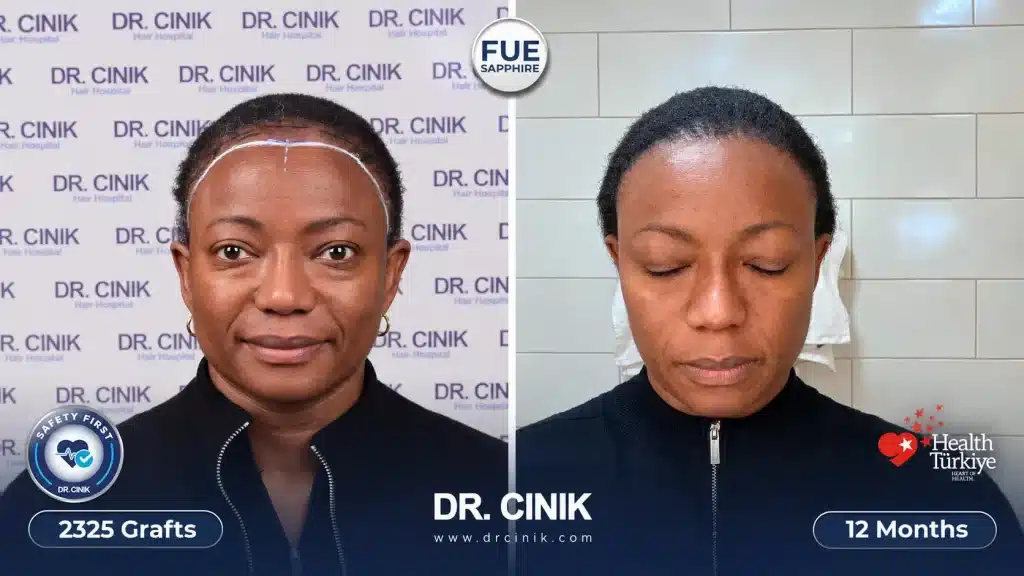
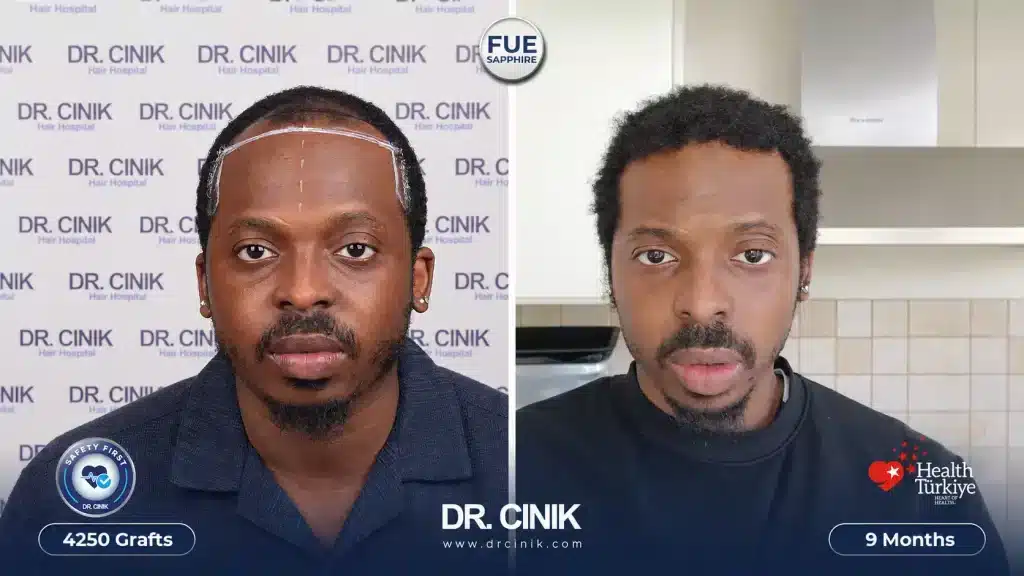
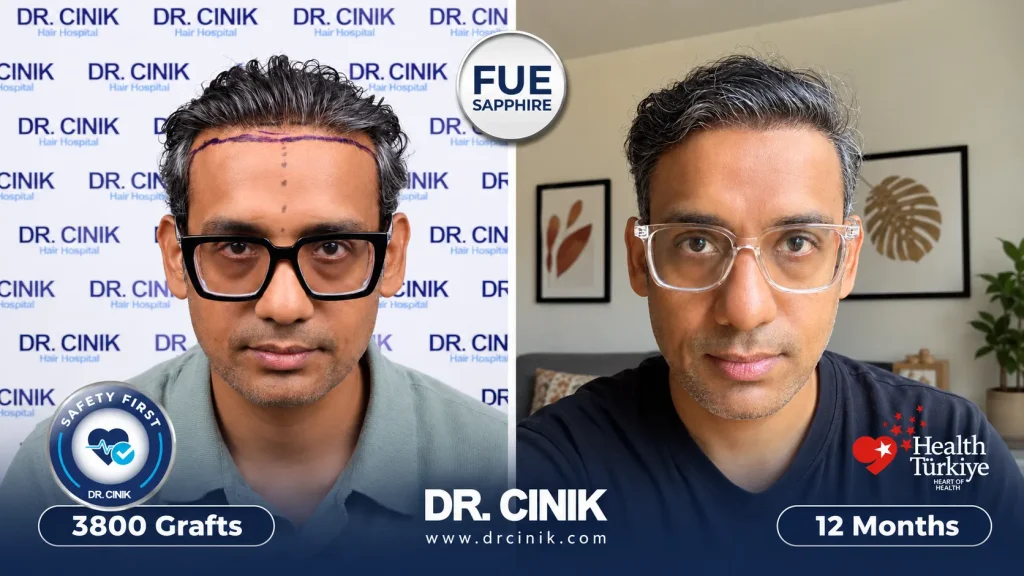
Three methods are available. FUE Classic uses traditional follicular extraction at €2,390. Sapphire FUE employs advanced sapphire blade technology to reduce trauma on the scalp and allow for better graft healing. At €2,690. DHI (Direct Hair Implantation) uses the Choi pen method for maximum density at €2,990.
Every package includes:
- VIP airport-clinic-hotel transfers
- Four-star hotel accommodation
- All surgical fees and medical team costs
- PRP therapy for enhanced healing and growth
- Post-operative medications and care kit
- Lifetime guarantee on transplanted follicles
- 24/7 patient coordinator support
There are no hidden fees.
Dr Cinik brings over 20 years of exclusive hair restoration focus, with more than 50,000 successful procedures performed. The clinic has extensive international patient experience, with roughly 30% of patients coming from North America. Advanced techniques like Sapphire FUE and DHI are offered as standard options, not premium upgrades. Pricing is transparent with no surprise costs.
The reality is simple: hair loss affects over 60% of Canadian men. Hair transplants work.
Where you get it done comes down to money and logistics.
If saving $8,000 to $15,000 whilst getting a surgeon who performs this procedure hundreds of times yearly makes sense to you, the Turkish option deserves serious research. If local convenience matters more and you’d rather stay in Canada, Canadian clinics will serve you well.
Either way, you’re taking action on something that affects your confidence and self-image.
That’s worth doing right, wherever you choose to do it. Get a free consultation to explore your options and get a personalized assessment.