en
en Hair Transplants: UK vs Turkey : what Nobody Actually Tells You


Summary
You’ve probably spent hours going down the Google rabbit hole, looked at a hundred clinic websites, and you’re still confused about why a procedure in Harley Street costs three times what you’d pay in Istanbul.
The price gap seems dodgy, doesn’t it? There must be a catch somewhere.
Turkey hasn’t just found a way to do hair transplants cheaper. They’ve built a completely different system that UK clinics simply can’t compete with. We’re talking over 150,000 hair transplants done in Turkey yearly. Compare that to maybe 3,000 across the entire UK.

Think about what that means practically. A busy Turkish surgeon does in six months what most British practitioners might do in five years. That’s not a small difference, it completely changes the game.
Why volume actually matters (more than you’d think)
Istanbul became the world capital for hair transplants because of sheer numbers. There are over 350 specialist clinics packed into one city. That creates this intense environment where techniques get refined constantly, innovation thrives.
Look at somewhere like Dr Cinik’s practice. They’ve been going for twenty years, treated 50,000 patients, doing roughly 2,500 procedures every year. The facility itself is massive, 5,000 square metres with 28 operating theatres, all focused purely on hair work. You’ve got 65 professionals who do nothing else, day in and day out.

And here’s why that matters to you: when you’ve done thousands of these procedures, you spot problems before they happen. Your technique becomes instinctive. The artistic bit, designing a natural-looking hairline, becomes second nature.
British surgeons? Even the busy London practices might do 200-300 transplants a year. That’s just not enough repetition to build the same level of expertise. It’s not their fault, the market’s simply smaller here. But the gap shows up in your results.
The technology situation (bit awkward for UK clinics)
When you actually compare what’s standard in each place, the differences are pretty stark.
- Sapphire FUE is the baseline technique at Dr Cinik, costs £2,450. These are proper sapphire blades that create tiny incisions, 0.6 to 0.8mm, about 30% more precise than traditional metal. The results? You heal 30% faster, less inflammation, and you get 20-25% better density. Back here in the UK, most places are still using basic metal FUE. Some are even doing the old strip method (FUT) that leaves you with a permanent scar across the back of your head.

- DHI (that’s the direct implantation method with the Choi pen) runs £3,050 at Dr Cinik. The grafts spend minimal time outside your body, which means better survival rates. The angle and direction control is spot on, that’s what makes it look natural rather than like you’ve had “work done.” The handful of UK clinics offering this? You’re looking at £6,000 to £8,000 minimum.

- And then there’s PRP therapy. This always gets included with Dr Cinik’s packages. In the UK, when clinics even offer it, they’re charging £300-500 extra. The research shows PRP improves graft survival by about 25%. Your new hair typically starts growing 3-4 weeks earlier. That’s not nothing.

What you actually pay in the UK (and what they don’t mention upfront)
British pricing works on this per-graft model that can get very expensive. London places charge £2.50 to £4 per graft. So 3,000 grafts? That’s £7,500 to £12,000 just for the procedure.
But that’s never the full story, is it? Then you’ve got:
- Hotel: £100-250 per night if you don’t leave by a clinic.
- Getting to and from the clinic: £50-100 each way
- PRP, if they even do it: £300-500 extra
- Your post-op medications and care kit: more money
Your actual bill ends up at least a grand more than what they quoted you initially. Sometimes two.

The techniques themselves? Bit behind the times, honestly. FUT (the strip method) is still common across UK clinics even though it leaves this permanent scar across the back of your head. They’ll tell you it’s “more economical”, maybe for them, but you can never have short hair again without showing that scar.
Basic metal FUE exists here, sure, but that’s entry-level stuff now. Sapphire FUE and DHI? Reserved for the premium London places charging premium prices. Creates this weird situation where only wealthy patients get access to the best techniques.
The only real advantage staying in the UK gives you is proximity. But is that worth an extra five grand? Language barriers aren’t really a thing anymore, Dr Cinik’s place has dedicated English-speaking medical staff throughout your stay. UK regulation is reassuring, granted, but Turkish standards meet the same international benchmarks, including ISHRS protocols.
What proper transparency looks like
Dr Cinik does three all-inclusive packages with no hidden costs. And I mean actually all-inclusive – not the usual “all-inclusive*” with seventeen asterisks.

- Classic FUE at £1,995 – proven follicular extraction, works well for moderate hair loss (that’s Norwood stages 3-4 if you’ve been reading up on the scales). Solid, reliable results with established technique.
- Sapphire FUE at £2,450 – this is the one most people go for. Ultra-precise sapphire blades, you heal 30% faster, 20-25% better density, minimal inflammation. Works for any stage of baldness.
- DHI at £3,050 – top-end option. Maximum possible density through direct implantation. No pre-incision needed, grafts spend minimal time outside your body, recovery’s quicker.
Every single package includes:
- The complete procedure by qualified medical team
- However many grafts you actually need (2,000, 3,000, 4,000, 5,000 – they don’t cap it)
- 5-star hotel stay
- Private transfers (airport-hotel-clinic-airport)
- PRP treatment as standard
- Full post-op care kit with specialist shampoo, lotions, headband
- 12 months of follow-up with your own English-speaking coordinator
No surprises. No extras. That’s genuinely it.

Actual costs: London vs Istanbul (let’s do the maths)
Say you need 3,000 grafts. Here’s what you’d actually pay:
London:
- Procedure: £7,500-£9,000
- PRP: £400
- Hotel (2 nights): £300
- Transfers: £100
- Total: £8,300-£9,800
Manchester or Birmingham:
- Procedure: £6,000-£7,500
- PRP: £350
- Hotel: £200
- Total: £6,550-£8,050

Dr Cinik Sapphire FUE:
- Complete package: £2,450
- Return flight from London: £150-£250
- Total: £2,600-£2,700
You’re saving 65-70%. That’s not marketing spin – that’s just basic arithmetic.
Flight from Manchester is similar, Birmingham too. Even from Scotland or Belfast you’re looking at under £300 return. Istanbul’s only 3.5 hours from London, it’s not exactly the other side of the world.
Recovery and results (what actually happens)
Timeline varies quite a bit depending on the technique and protocol:

With Dr Cinik’s approach:
- Properly healed: 1 month (Sapphire speeds this up by about 30%)
- You’ll see new growth starting: Month 3 (PRP brings this forward by 2-3 weeks)
- About half your final result: Month 6 (without PRP you’d only be at 40-45%)
- Full result with maximum density: Month 12
The clinic’s treated quite a few footballers you’d recognize – Ivan Rakitić, Ludovic Giuly, Rivaldo. Patient satisfaction sits consistently above 98% in verified reviews.

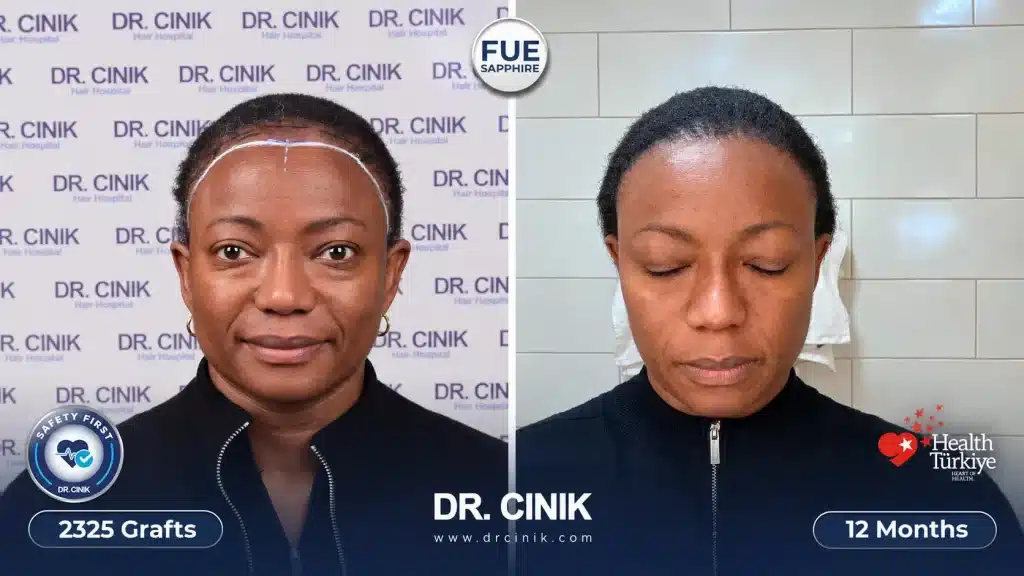
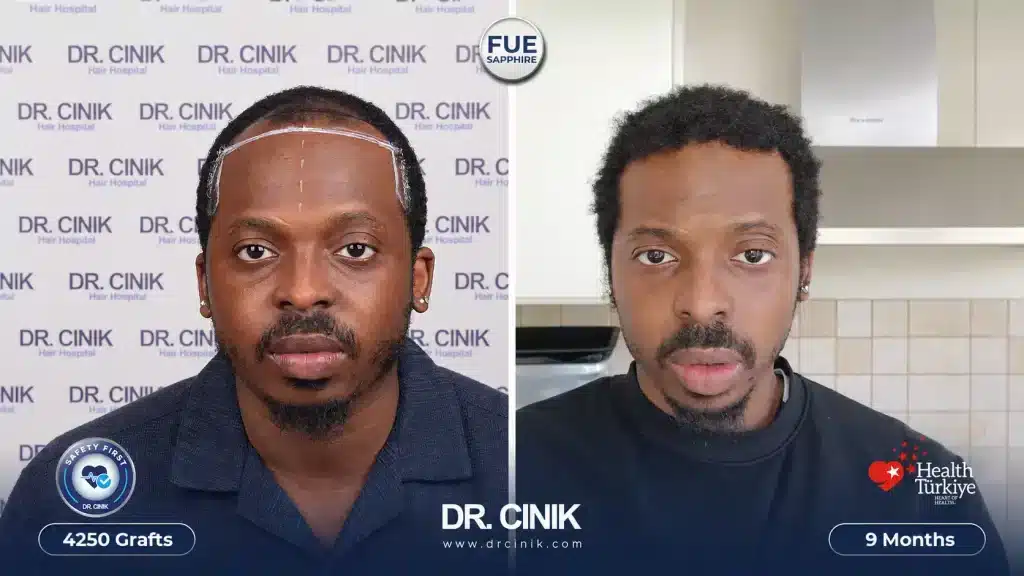
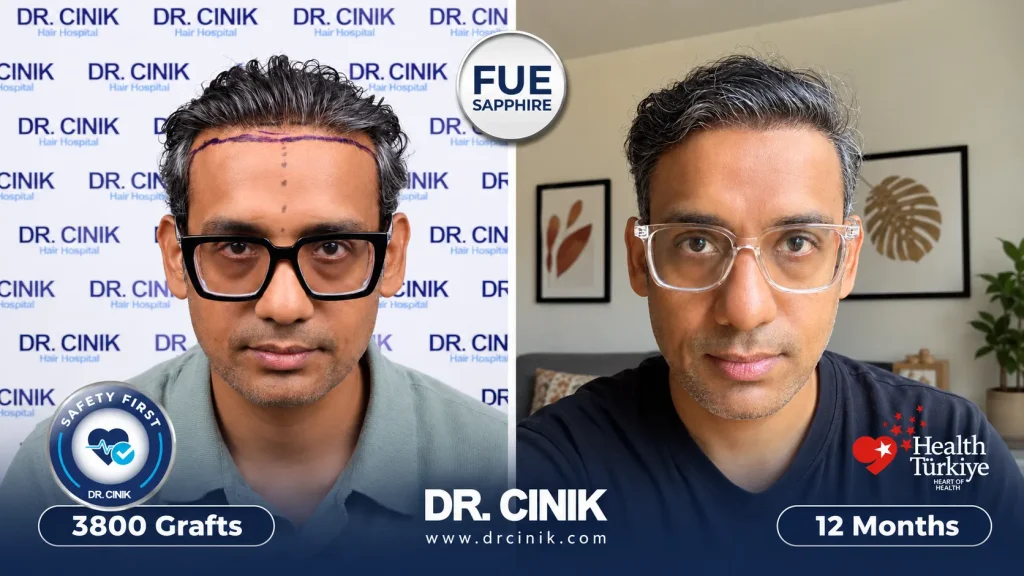
But here’s what matters more than celebrity endorsements: the photos from regular blokes who’ve had it done. Browse through their gallery and you’ll see what’s actually achievable. Before and afters from people with similar hair loss patterns to yours.
Making sense of your options
Stay in the UK if:
- Money genuinely isn’t an issue (£6,000-£10,000 isn’t a concern)
- You absolutely won’t get on a plane
- Being able to pop back easily matters more than anything else
- You’re okay potentially getting older techniques
Go to Turkey and Dr Cinik if:
- You want the best value without compromising quality
- You’d like access to the latest proven techniques
- The included extras (PRP, better technology) make sense to you
- You value the expertise that comes from doing thousands of these

There’s no objectively “right” answer – it depends what matters most to you. Just make sure you actually understand what you’re getting in each scenario, and what you’re paying for.
The flight’s 3.5 hours. You’re there for three nights. It’s not a massive undertaking – people do it for a weekend city break. Except you’re coming back with the start of a new hairline rather than a hangover.
References:
Goldin, J., Zito, P. M., & Raggio, B. S. (2025). Hair transplantation. In StatPearls. StatPearls Publishing.
International Society of Hair Restoration Surgery. (2025). 2025 Practice Census Results.
Mysore, V., & Hair Transplant Guidelines Task Force. (2021). Hair transplant practice guidelines. Journal of Cutaneous and Aesthetic Surgery, 14(3), 265-284.
Vañó-Galván, S., et al. (2023). An international expert consensus statement focusing on pre and post hair transplant care. Journal of Dermatological Treatment, 34(1), 2232065.