en
en Hair transplant in turkey vs the US: what the numbers actually tell you


Summary
You’ve probably spent weeks (even maybe months) looking at before-and-after photos, reading reviews, getting quotes. And if you’re like most Americans researching hair restoration, you’ve hit the same wall: US clinics want $10,000-15,000, while Turkish clinics offer packages for $2,500-3,500.
Your first thought? “Yeah, right. What’s the catch?”

So we dug into the actual research. And here’s what surprised us: A 2021 study tracking 90 clinics worldwide found the average US procedure costs $13,610. Meanwhile, Americans say they’re actually willing to pay around $4,000-6,000. That massive gap? Turkey filled it.
Let’s get past the sticker shock and talk about what really matters: the results and the safety.
Why US hair transplants cost what they do
The math is pretty simple, honestly. Most US clinics charge $3-4 per graft. Sounds reasonable until you realize a typical restoration needs around 3,000 grafts. That’s $9,000-12,000 right there – before consultation fees ($100-500), PRP therapy if they even offer it ($300-500), and post-op visits some clinics charge separately.

Here’s the thing about volume: the average US hair transplant surgeon does 200-300 procedures a year. Takes them 5-10 years to hit 2,500 procedures total. A lot of dermatologists and plastic surgeons offer hair transplants alongside their main practice – it’s not their bread and butter.
And that affects pricing. Lower volume means higher overhead per patient. Malpractice insurance alone runs $50,000-100,000 annually. Medical real estate in major cities? $300-500 per square foot. When you’re only doing a couple hundred procedures yearly, those costs get spread across fewer patients.

What about the actual technology?
Most US clinics still use the FUT strip method (yep, the one that leaves a linear scar) or basic FUE with metal punches. Sapphire FUE – where they use crystal blades for more precise incisions – is rare and typically runs $10,000-15,000 when you can find it. DHI (direct hair implantation) is even harder to find at $12,000-18,000.
PRP therapy, which studies show improves graft survival by about 25%, is usually an expensive add-on rather than just… part of what they do.
Look, there are excellent surgeons in the US. But they’re concentrated in places like New York, LA, and Miami. And they’re not cheap.

How Turkey became the world’s hair transplant hub
Istanbul didn’t stumble into this. The city now has over 400 clinics that do nothing but hair transplants. Not a side hustle – it’s all they do.
The numbers are wild: Turkey does 150,000+ procedures annually. That’s more than the entire US does in a decade. Top Turkish surgeons handle 2,000-3,000 cases yearly. Think about what that means. A surgeon doing 2,500 procedures a year sees more different scalps in six months than most US surgeons see in ten years.

Here’s where it gets interesting:
That volume created what’s basically a specialization arms race. When you’ve got 400+ clinics competing for international patients, you can’t just compete on price – you need the latest tech. So what’s premium in the US becomes standard in Turkey.
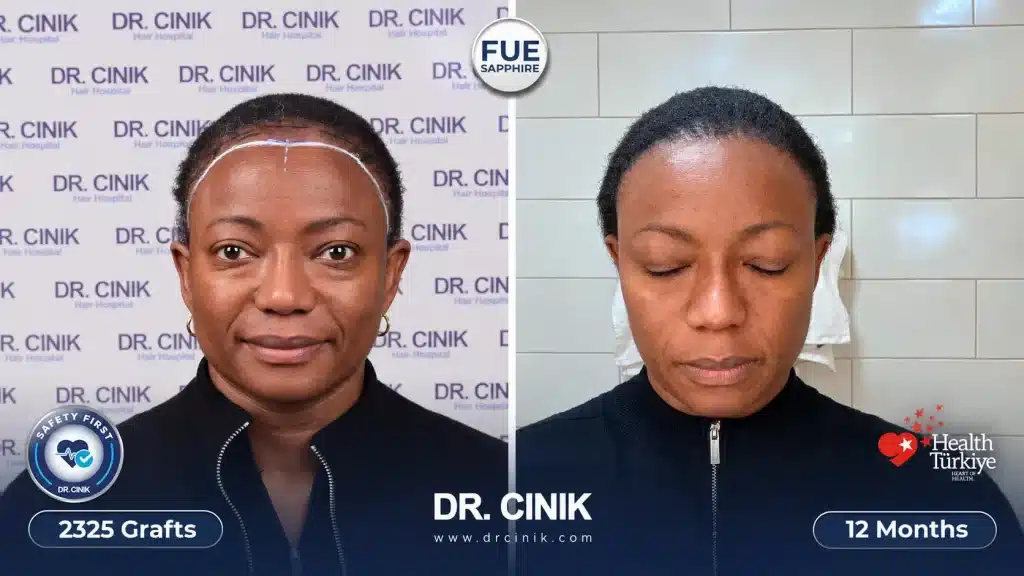
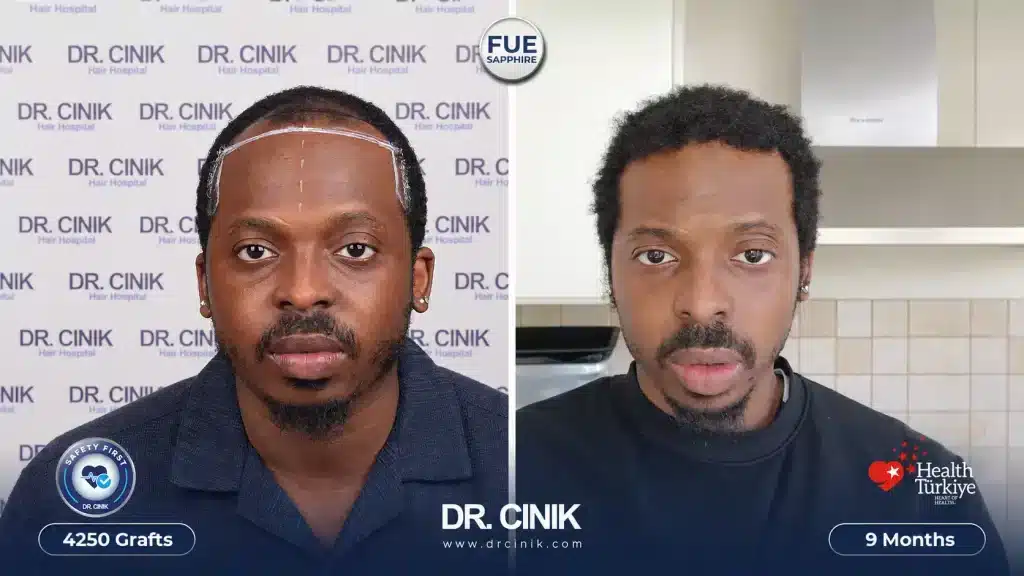
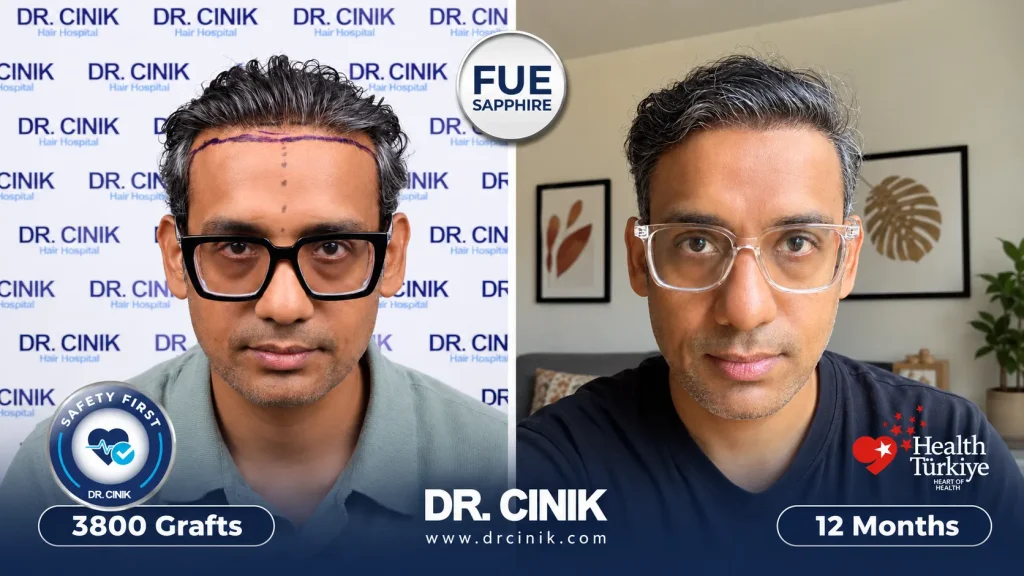
Take Sapphire FUE. Those crystal blades create 0.6-0.8mm incisions instead of the 0.9-1.2mm you get with metal. Research shows that translates to 30% faster healing and 20-25% better density potential. In the US? Premium upgrade. In Turkey at a place like Dr. Cinik’s clinic? Baseline for $2,890.

DHI keeps grafts outside your body for less than 15 minutes (versus 45+ with standard FUE), and that matters for survival rates. US price: $12,000-18,000. Quality Turkish clinic: $3,590.
And PRP? A 2016 study followed 40 patients and found 100% of the PRP-treated group hit over 75% follicle growth, compared to just 20% without it. In Turkey, that’s included. In the US, it’s a $300-500 “would you like fries with that?”

Here’s the actual cost breakdown:
Say you need 3,000 grafts with Sapphire FUE:
US total:
- Surgery: $9,000-12,000
- PRP: +$400
- Hotel if traveling: +$300-600
- Transportation: you figure it out
- Meds: +$200
- Grand total: $10,000-13,000+

Turkey (Dr. Cinik):
- All-inclusive package: $2,890
- Includes: 5-star hotel, VIP transfers, PRP, meds, post-op kit
- Your flight: +$600-800
- Grand total: $3,500-3,700
You save: $6,500-9,500
That’s not pocket change. That’s 65-75% less for the same (or better) technology.
“But wait – medical tourism risks?”
Yeah, we get this question constantly. And it’s smart to ask.
Here’s what the data shows: a 2021 study tracked 2,896 hair transplant patients over ten years. Total complication rate? 0.10%. Most common issues were temporary folliculitis (about 7% of patients) and minor swelling (0.6%). Zero major complications when proper technique was used.

A 2025 review in Aesthetic Plastic Surgery looked specifically at Turkey’s hair transplant scene. Yes, there’s quality variability – but the key finding was this: risks correlated with “differences in resources, surgeon experience, technology, and safety protocols,” not geography. Translation: a well-run Istanbul clinic is just as safe as a well-run Manhattan one.
What you actually need to verify:
Clinics doing 1,000+ procedures yearly – that’s real specialization, not a side gig. ISHRS affiliation or international accreditation. English-speaking support for the full 12 months (though honestly, most healing happens in the first 10-14 days you’ll spend there anyway).
Red flags to avoid:
Packages under $2,000 (corners are being cut somewhere). Technicians doing extraction instead of the surgeon. Promises of density over 100 grafts per square centimeter (not realistic). No verifiable before-after documentation.
What actually happens long-term
A 2021 study followed 112 patients for four years. About 51% maintained excellent density, 46% had very good density, and only 8% showed significant reduction. Bottom line: when it’s done right, it lasts.

But success doesn’t depend on your zip code. It depends on things like keeping grafts outside your body under 2 hours, storing them at 4°C in the right solution, and implanting them at a 40-45 degree angle for natural-looking growth. That’s about the surgeon’s skill and the clinic’s protocols.
There’s also this interesting study where researchers showed 122 people before-and-after transplant photos. Results? Successful restoration made people look about 3.6 years younger, with big jumps in perceived attractiveness and success. When it works, it really works – doesn’t matter if it was done in Boston or Istanbul.
So should you do it?
Look, staying in the US makes sense for some people. If you’ve got health conditions needing local monitoring, or you absolutely can’t travel, or the idea of international medical care keeps you up at night – then maybe that extra $6,000-9,000 buys you peace of mind.
But the evidence is pretty clear: choose a verified clinic with high volume, proper accreditation, and transparent results, and you’re getting equal or better tech for 70% less.
Dr. Cinik’s clinic is a solid example. 50,000+ procedures over 20 years in a 5,000 square-foot facility with 28 dedicated operating rooms. Sapphire FUE: $2,890 (versus $10,000-12,000 in the US). DHI: $3,590 (versus $12,000-18,000). Classic FUE: $2,350 for less extensive cases.

Every package includes:
- PRP therapy (that 25% better outcome thing)
- 5-star hotel
- VIP airport transfers
- All meds and post-op supplies
- 12 months of English-speaking support

Quick math:
Turkey all-inclusive: $2,890-3,590
Your flight: +$600-800
Time away: 7-10 days
Total: $3,500-4,400
US equivalent: $10,000-13,000 minimum
Time away: 3-5 days (local though)
Total: $10,000-13,000
The difference could cover a pretty nice vacation in Istanbul. Which, if you’ve never been, is an incredible city.

The real bottom line
We’ve gone through the numbers, the studies, the actual data. The question isn’t whether Turkey can deliver quality results – research shows top clinics produce outcomes matching or exceeding US standards.
The real question: is saving $6,500-9,500 worth 7-10 days of travel and stepping outside your comfort zone?

For 150,000+ Americans and Europeans every year, the answer is yes. That’s not marketing – that’s a $1 billion industry built on word-of-mouth and actual satisfaction.
Ready to explore this? Start with a free consultation. Get your photos analyzed, find out your realistic graft count, understand which technique fits your situation, see the actual all-inclusive pricing. Then decide with facts instead of fear or hype.
If you’re researching hair transplant in Turkey, understanding the hair transplant timeline and learning about proper post-operative care will help you prepare for the best possible results.

References:
Goldin, J., Zito, P. M., & Raggio, B. S. (2025). Hair transplantation. In StatPearls. StatPearls Publishing. https://www.ncbi.nlm.nih.gov/books/NBK547740/
Haider, S. A., Hasanzade, S., Borna, S., Gomez-Cabello, C. A., Pressman, S. M., Genovese, A., Trabilsy, M., Prabha, S., Collaco, B. G., & Forte, A. J. (2025). The allures and the alarms of the hair transplant tourism industry. Aesthetic Plastic Surgery. https://pubmed.ncbi.nlm.nih.gov/40660034/
Hu, R., Xu, F., Han, Y., Sheng, Y., Qi, S., Liu, X., & Yang, Q. (2015). Perception of hair transplant for androgenetic alopecia. JAMA Facial Plastic Surgery, 17(3), 163-168. https://pmc.ncbi.nlm.nih.gov/articles/PMC5469375/
Patwardhan, N., Mysore, V., & Sharma, M. (2016). Outcome of intra-operative injected platelet-rich plasma therapy during follicular unit extraction hair transplant: A prospective randomised study in forty patients. Journal of Cutaneous and Aesthetic Surgery, 9(3), 157-164. https://pmc.ncbi.nlm.nih.gov/articles/PMC5064679/
Perez-Zuñiga, J. M., Somma, F., & Boni, R. (2022). Hair transplantation in the United States: A population-based survey of female and male pattern baldness. Dermatologic Surgery, 49(1), 30-36. https://pmc.ncbi.nlm.nih.gov/articles/PMC10642908/
Puri, N., & Puri, A. (2013). Follicular unit extraction hair transplant. Journal of Cutaneous and Aesthetic Surgery, 6(1), 10-16. https://pmc.ncbi.nlm.nih.gov/articles/PMC2956961/
Umar, S. (2021). Complications of hair transplant procedures—causes and management. World Journal of Plastic Surgery, 10(3), 3-18. https://pmc.ncbi.nlm.nih.gov/articles/PMC8719980/
Vañó-Galván, S., Bisanga, C. N., Bouhanna, P., Farjo, B., Gambino, V., Meyer-González, T., & Silyuk, T. (2023). An international expert consensus statement focusing on pre and post hair transplantation care. Journal of Dermatological Treatment, 34(1), 2232065. https://pubmed.ncbi.nlm.nih.gov/37477225/
Venkataram, M., Patel, M. H., Mysore, V., & Rajput, R. (2021). Longevity of hair follicles after follicular unit transplant surgery. Journal of Cutaneous and Aesthetic Surgery, 14(2), 177-181. https://pmc.ncbi.nlm.nih.gov/articles/PMC8061642/