en
en 

Sleep and hair growth: why your body clock matters

Summary
This is not the article about which side to lie on after surgery. That question, the pillow, the angle, the first few nights, we handle separately. This one is about biology: whether the quality and the timing of your sleep change the way hair actually grows. For years the link between short nights and tired hair was intuition, nothing more. It now rests on data. A systematic review published in 2026 gathered the work sitting at the intersection of sleep and hair loss, and separate research on circadian rhythm shows that the hair follicle runs a clock of its own. Disturb that clock and you disturb a small factory that never stops producing. Here’s what the science establishes, what it only suggests, and what follows from it at bedtime.
Your follicle keeps its own clock
Hair doesn’t grow in a straight line. It cycles through active growth, a short transition and a resting phase, all driven by cell activity that never quite pauses. And those cells are not indifferent to the time of day. Work published in a European dermatology journal showed that prolonged circadian disruption alters the regenerative properties of the human follicle. The genes of the biological clock are expressed right down into the hair bulb, and when they fall out of sync, the cells that build the shaft start behaving differently. So your hair isn’t simply growing by night or by day. It’s keeping tempo, and that tempo drifts when yours does.
That matters more than it sounds. Growth here is a matter of months, not minutes, so nothing shows up the morning after a bad night. What a follicle registers is the pattern: weeks of shifting bedtimes, seasons of broken sleep, a work rota that moves every fortnight. By the time the effect reaches the mirror, the cause is already months behind you, which is exactly why sleep so rarely gets blamed.
What the recent research actually shows
Three publications give the measure of it. A 2024 study in iScience identifies chronic circadian misalignment, the kind produced by night shifts or wildly irregular hours, as a risk factor for impaired hair growth. A 2025 analysis in Chronobiology International looked at the association between sleep patterns, circadian rhythms and hair loss. The 2026 systematic review then pulls this still young body of work together.
A point of honesty belongs here. These studies establish associations and plausible mechanisms. They do not yet establish cause and effect measured across large cohorts, and anyone telling you otherwise is running ahead of the evidence. Scientific caution applies. But the findings converge cleanly enough that sleep deserves a place in any serious approach to hair.
Why short nights weigh on your hair
Several mechanisms stack up. The first is hormonal. Sleep debt raises cortisol, the stress hormone, and cortisol pushes more follicles towards their resting phase, which is precisely the machinery behind reactive shedding.
The second is inflammatory. Chronic lack of sleep sustains low grade inflammation, and an inflamed scalp is poor ground for anything to grow in, a subject we go into on our page about an itchy scalp and hair loss.
The third has to do with circulation and repair. Deep sleep supports microcirculation and the regenerative processes the bulb depends on. None of this causes androgenetic alopecia, which remains genetic and hormonal in origin, and no amount of sleep will switch that off. But poor sleep can accelerate a loss already under way, and make fragile hair more fragile still.
Sleep and reactive shedding: the vicious circle
There is one scenario where sleep plays a direct part: the diffuse shedding triggered by a significant period of stress, an emotional shock or months of overwork, usually with broken sleep alongside it. The mechanism is well described. Several weeks after the event, a wave of hair tips into the resting phase and falls.
The trap is what happens next. You notice the shedding, the shedding worries you, the worry wrecks your sleep, and round it goes. Breaking that loop matters as much as any product you could put on your scalp. The good news is real: reactive shedding is reversible, and regrowth generally follows once a normal rhythm returns. Patience is the hard part, since the recovery runs on the same slow clock as the loss did.
What actually helps at night
A few markers, consistent with what the circadian research shows. Seven to nine hours a night remains the reference range for an adult. More important still is regularity, weekends included, because it’s the gap between your nights rather than their average length that knocks the internal clock out of phase.
Then the basics that have earned their place: daylight in the morning, screens dialled down in the evening, a cool dark bedroom, coffee cut off in the early afternoon. On the hair side, a satin or silk pillowcase reduces friction on the fibre, and long hair is better tied loosely than tightly. These details won’t revive a dead follicle. They simply stop you adding mechanical breakage to a fibre that’s already weakened.
And if you work nights, none of the above is a reproach. Some rotas can’t be argued with. What can usually be improved is the edge of them: anchoring your sleep block at roughly the same hours on your days off, getting proper light exposure when you wake whatever the hour, and treating your recovery days as recovery rather than as a chance to swing your schedule back and forth twice a week.
And after a hair transplant?
In the days following surgery, sleep stops being a lifestyle question and becomes a medical parameter. Sleeping with your head elevated for the first nights limits swelling, and keeping the grafts off the pillow protects their anchoring. Those instructions open our post-operative guidelines, and we go through the practical detail of position and pillows in our guide on how to sleep after an FUE hair transplant. The one month follow up sets out how long to keep applying them.
Over the longer run, good sleep supports healing and the regrowth phase, the one that stretches across months. It doesn’t make the grafts more permanent, they already are by nature. It just puts everything on the side of the result.
When sleep isn’t the problem
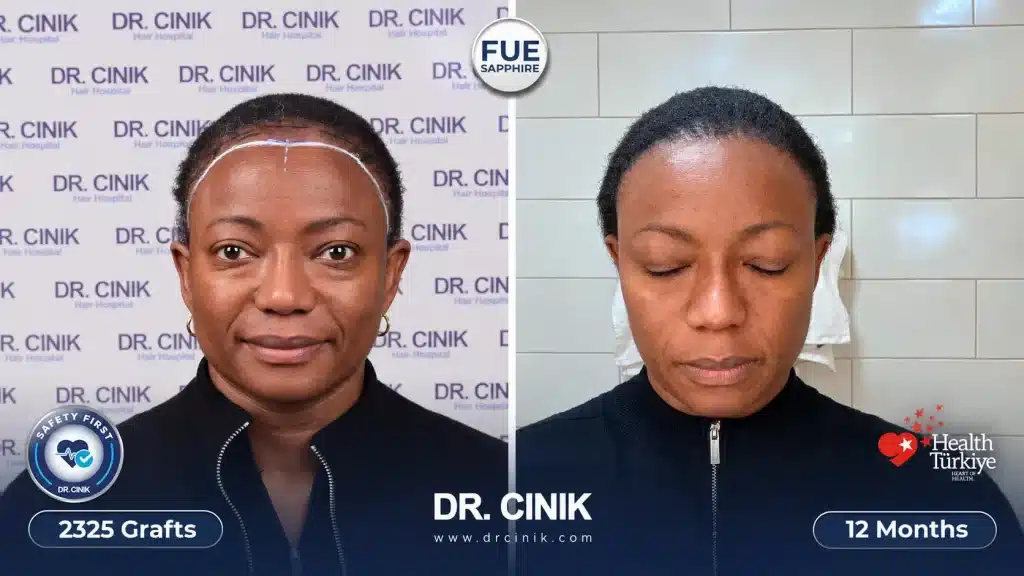
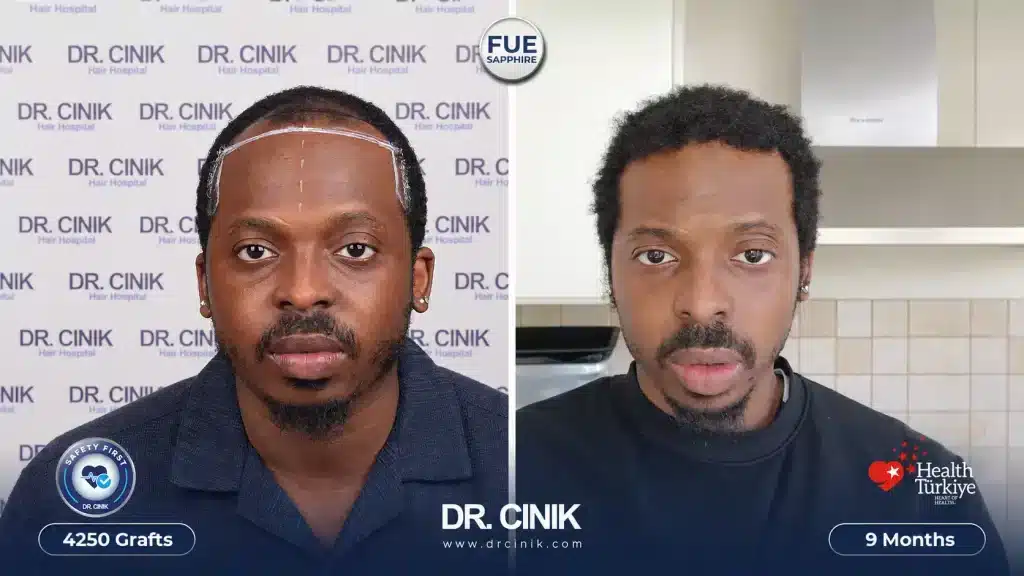
If your nights are decent and your hair is thinning anyway, look elsewhere. A hairline receding at the temples, or a crown opening up, points to hereditary loss that the best sleep in the world will not stop. In that case a transplant remains the most durable treatment, and our before and after results show what that looks like on real patients. An honest diagnosis beats six months of supplements.
A hair transplant Turkey plan always starts with that assessment. A few photos through our contact page are enough for the team of Dr Emrah Cinik to place your type of loss and tell you straight what belongs to lifestyle and what belongs to surgery.
Sources
Boghosian, T., Mendez, H., & Sayegh, M. (2026). The intersection of sleep and hair loss: A systematic review. Dermatology and Therapy. https://doi.org/10.1007/s13555-025-01641-6
Miyawaki, Y., Nishida, A., & Fukushima, K. (2024). Chronic circadian misalignment is a risk factor for hair growth impairment. iScience, 27(9). https://doi.org/10.1016/j.isci.2024.110974
Wu, Q., Li, M., & Xiong, Y. (2025). Association between sleep patterns, circadian rhythms, and hair loss. Chronobiology International. https://doi.org/10.1080/07420528.2025.2547938
Deshayes, N., Genty, G., & Berthelot, F. (2018). Human long-term deregulated circadian rhythm alters regenerative properties of skin and hair precursor cells. European Journal of Dermatology, 28(4). https://doi.org/10.1684/ejd.2018.3358